The average American uses roughly 100 feet of plastic wrap per year — most of it going straight to landfill, where it takes centuries to break down.[1] Bee's Wrap is one of the few alternatives that has moved beyond novelty to genuinely replace it in a kitchen drawer.
This article covers what Bee's Wrap is made of, which certifications it holds and what those certifications actually verify, where the brand's claims hold up under scrutiny, and which products are worth buying first.
About Bee's Wrap
Bee's Wrap was founded in 2012 by Sarah Kaeck, a Vermont beekeeper who wanted a plastic-free way to store food. The product is simple: organic cotton muslin coated in a mixture of beeswax, organic jojoba oil, and tree resin. You warm it with your hands, mold it around food or over a bowl, and it holds its shape as it cools. Wash it in cool water with mild soap and it lasts roughly a year with regular use.[2]
The fabric used in Bee's Wrap is certified to the Global Organic Textile Standard (GOTS), which is one of the stricter third-party certifications in the textile industry. GOTS requires that at least 70% of fiber content be certified organic, prohibits a long list of synthetic inputs during processing, and includes social criteria for the workers making the material.[3] The cotton in Bee's Wrap meets the higher 95% threshold.
The beeswax itself comes from U.S. suppliers. Bee's Wrap does not make specific claims about the beeswax being certified organic — beeswax is structurally difficult to certify organic because bees forage over a wide radius that can't be fully controlled. That's an honest limitation of the ingredient, not a red flag about the brand.
Bee's Wrap is a certified B Corporation, which means it has been independently audited by B Lab across five categories: governance, workers, community, environment, and customers.[4] B Corp certification doesn't verify individual product claims — it evaluates overall business practices. It's a meaningful signal but not a substitute for product-level certifications.
On the plastic question: Bee's Wrap products contain no polyethylene, no polyvinylidene chloride (PVDC), and no BPA or its chemical relatives BPS or BPF. The coating is food-contact safe. The product is not appropriate for raw meat storage or microwave use — the brand is clear about this, which is the right call. When a wrap reaches end of life, it can be composted in a home compost bin.[5]
Top Products Worth Knowing
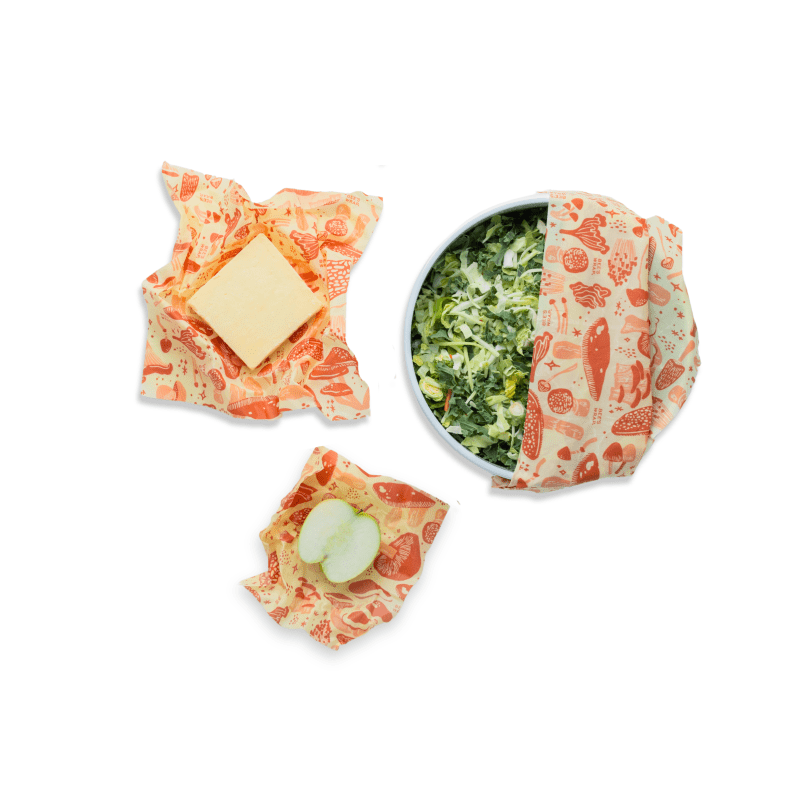
Bee's Wrap Assorted 3 Pack
This is the right starting point. The three sizes — small, medium, and large — cover most food storage tasks: half a lemon, a chunk of cheese, a cut avocado, the top of a mixing bowl. The GOTS-certified organic cotton fabric is what you're paying for here, and the sizing assortment means you'll actually reach for the right one rather than wrestling an oversized wrap around something small.[2]
See price →
Bee's Wrap Bread Wrap
The XL Bread Wrap is purpose-built for a standard loaf. It's oversized enough to fold and tuck around a full loaf of sourdough without tearing, and the beeswax coating provides a modest moisture barrier that slows staling compared to leaving bread exposed. It won't replace a sealed bread box for multi-day storage, but it outperforms the plastic bag it's replacing for one to two days.[5]
See price →
Bee's Wrap Snack & Sandwich Bags
These are the brand's answer to the zip-lock bag. They're lined with the same beeswax-coated fabric and sealed with a fold-and-press closure rather than a zipper. Crackers, sliced fruit, and sandwiches all work well. They're not liquid-tight, so don't expect them to hold yogurt or soup. For dry and semi-dry snacks going into a lunchbox, they're a straightforward swap.[2]
See price →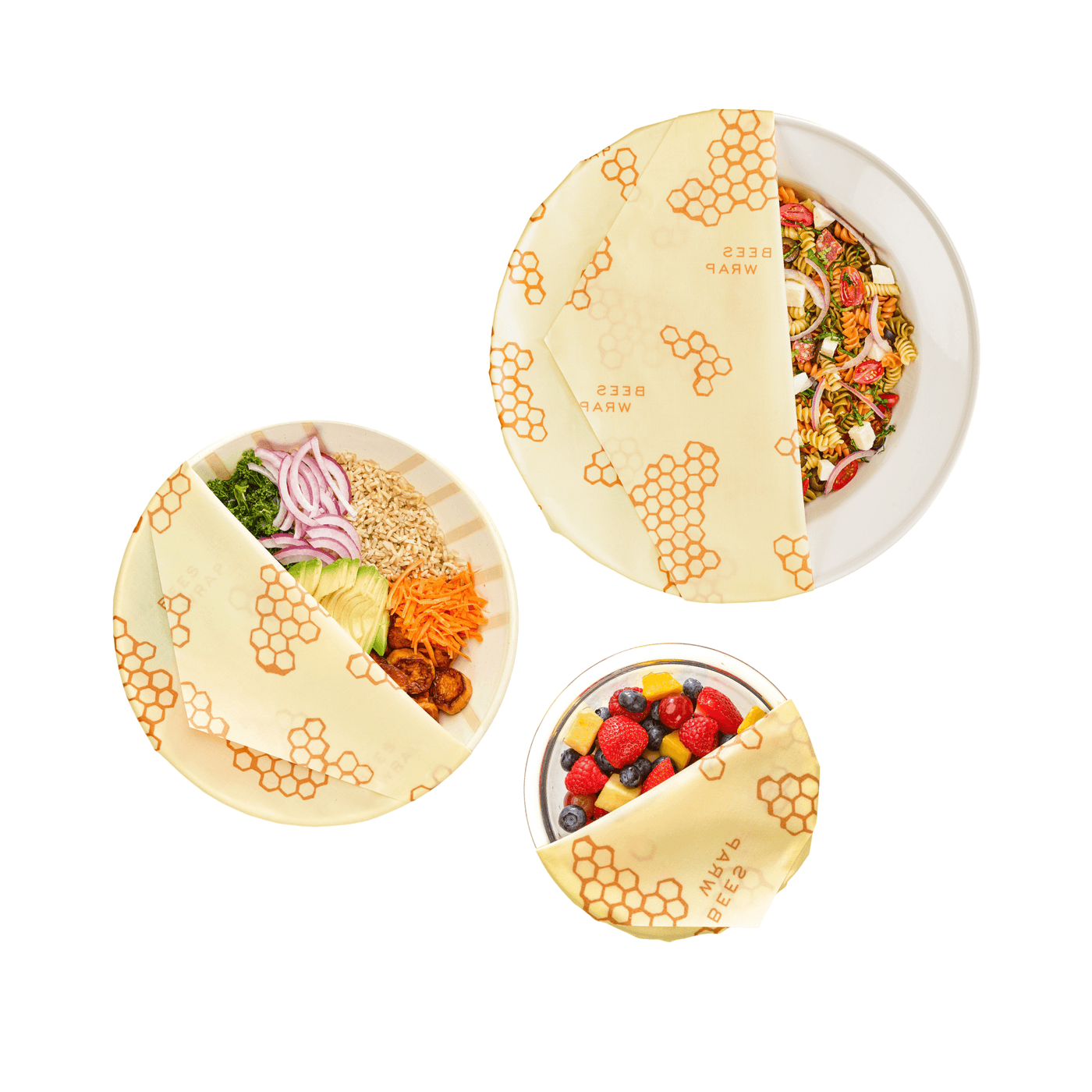
Bee's Wrap HexHugger Bowl Cover 3 Pack
The HexHugger is shaped differently from the standard wraps — it has a hexagonal cut with notched edges that create a better mechanical grip around bowl rims. The three-pack covers small, medium, and large bowls. If you regularly cover leftovers overnight in the fridge, this is the format that actually stays put without the fussiness of wrapping a flat sheet.[5]
See price →Why These Certifications Matter
Bee's Wrap qualifies for three filters on this site: sustainable">sustainable, BPA-free, and organic. Each means something specific. The BPA-free designation applies because the wraps contain no polycarbonate plastic, no epoxy resin lining, and none of the bisphenol compounds — BPA, BPS, or BPF — associated with endocrine disruption.[6] This matters most when storing food for children or during pregnancy, where precautionary avoidance of endocrine disruptors is well-supported by the scientific literature.[7]
The organic filter is backed by the GOTS certification on the cotton — a third-party standard, not a self-declared claim. GOTS prohibits genetically modified fiber, synthetic pesticides during cultivation, and a list of toxic processing chemicals including formaldehyde-based finishing agents and azo dyes.[3] The sustainable filter reflects the composability of the product at end of life, the B Corp certification, and the straightforward math that one wrap replacing hundreds of single-use plastic sheets reduces landfill volume regardless of which lifecycle methodology you use.[8]
Frequently Asked Questions
Is Bee's Wrap actually safe for food contact?
Yes, for the uses the brand specifies. The beeswax, jojoba oil, and tree resin coating is food-contact safe. The product is not appropriate for raw meat storage — the porous fabric can harbor bacteria — and it shouldn't be used in a microwave or conventional oven because the wax melts above approximately 65°C (150°F). Within those limits, it's a straightforward food-safe material with no plastic, no BPA, and no synthetic coatings.
How long does Bee's Wrap last before it needs to be replaced?
The brand estimates roughly one year with regular use, washing after each use in cool water with mild dish soap. Hot water degrades the wax coating faster. Some users report wraps lasting 18 months or longer with careful washing. When the wrap stops sticking or the fabric becomes thin and worn, it's past its useful life — at that point, it can go into a home compost pile.
Can Bee's Wrap be used to store meat or fish?
No — and the brand says so clearly. The woven cotton fabric is not easy to fully sanitize after contact with raw meat or fish. Cross-contamination risk is real. For raw protein storage, sealed containers or butcher paper are the appropriate choice. Bee's Wrap is designed for produce, cheese, bread, snacks, and covering bowls of cooked leftovers.
What does the GOTS certification on Bee's Wrap actually verify?
GOTS (Global Organic Textile Standard) is a third-party certification covering the entire textile supply chain from fiber to finished product. For Bee's Wrap, it verifies that the cotton is grown without synthetic pesticides or GMOs, that processing chemicals meet a restricted substances list, and that social standards for workers are met. It does not cover the beeswax component, which is not separately certified organic — an inherent limitation of beeswax given how bees forage.
Is Bee's Wrap genuinely better for the environment than plastic wrap?
On lifecycle terms, yes — with caveats. A single Bee's Wrap can replace roughly 260 square feet of single-use plastic wrap over a year of use, eliminating that plastic from the waste stream. The product is home compostable at end of life. The manufacturing footprint is higher per unit than a roll of plastic wrap, but the reuse factor more than offsets it across a full year. The honest caveat: lifecycle assessments vary by methodology, and the brand has not published an independent LCA. The directional case for reduced environmental impact is strong; the precise numbers are not independently verified.
References
- U.S. Environmental Protection Agency. (2023). Plastics: Material-Specific Data. EPA.gov. https://www.epa.gov/facts-and-figures-about-materials-waste-and-recycling/plastics-material-specific-data ↩
- Bee's Wrap. (2024). How It Works. beeswrap.com. https://www.beeswrap.com ↩
- Global Organic Textile Standard. (2023). GOTS Version 7.0 Standard. global-standard.org. https://www.global-standard.org/the-standard/gots-version-7 ↩
- B Lab. (2024). B Corp Certification Overview. bcorporation.net. https://www.bcorporation.net/en-us/certification ↩
- Bee's Wrap. (2024). Product Care and Composting. beeswrap.com. https://www.beeswrap.com/pages/faq ↩
- Vandenberg, L. N., et al. (2013). Hormones and Endocrine-Disrupting Chemicals: Low-Dose Effects and Nonmonotonic Dose Responses. Endocrine Reviews, 33(3), 378–455. https://doi.org/10.1210/er.2011-1050 ↩
- National Toxicology Program, U.S. Department of Health and Human Services. (2008). NTP-CERHR Monograph on the Potential Human Reproductive and Developmental Effects of Bisphenol A. NIH Publication No. 08-5994. https://ntp.niehs.nih.gov/go/31700 ↩
- European Environment Agency. (2022). Textiles and the Environment: The Role of Design in Europe's Circular Economy. EEA Report No 6/2022. https://www.eea.europa.eu/publications/textiles-and-the-environment-the ↩